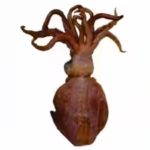







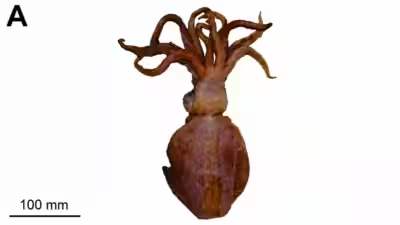
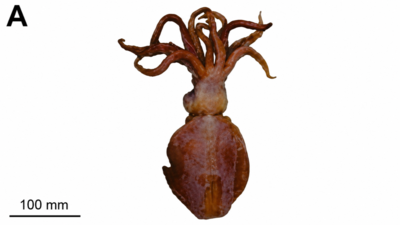
A single squid recovered from the stomach of a sperm whale has led scientists to propose an entirely new family of oceanic squids. Malcolm Clarke collected the specimen from a male sperm whale hunted in 1955–56 and first identified it as Ancistrocheirus lesueurii. According to the study published in Zoological Journal, titled ‘Diversity in the squid family Ancistrocheiridae and description of a new family of the order Oegopsida (Cephalopoda)’, it has white skin, no photophores and distinctive arm hooks. They named it Mobydickia poseidonii, placed it in the family Mobydickidae, and likened its hooks to Poseidon’s trident. Only one specimen of the squid is known.
How did scientists identify a new squid family
The researchers examined the morphology and DNA sequence of Ancistrocheirus lesueurii, the sole accepted member of the family Ancistrocheiridae. They reviewed the primary literature and, where possible, re-examined the type specimens of all Ancistrocheirus synonyms. The abstract states that this work revealed large morphological differences among the individuals examined, and that molecular analyses showed at least six cryptic Ancistrocheirus species.The specimen in question, NHM 20240079, was collected and identified as A. lesueurii by Malcolm Clarke. According to the paper, its label indicated only that it came from a male sperm whale taken between 1955 and 1956. Clarke was aboard the SS Southern Harvester that season. The authors used International Whaling Commission coordinates for the 341 male sperm whales hunted in the region to estimate where it was caught. They also examined Clarke’s digitised logbook, but it held no relevant information. The type locality is given as Antarctic or sub-Antarctic waters, an area covering the Bellinghausen Sea, the Drake Passage and the Scotia Sea.
What made the squid specimen different from others
The specimen was sampled outside the reported distribution range of the species. Its skin is white, whereas Ancistrocheirus is purple. No photophores were present, and chromatophores were found only around the eyes. The arm hooks differ in size and shape from those of all other studied specimens. They are larger and have one large main cusp and two accessory claws over a circular base.The authors also describe differences in the beak, radula and gladius. The lower beak has a wider wing gap, a comparatively longer hood and no fold in the lateral walls. In the radula, the lateral cusps of the rachidian teeth slope shallowly towards the main cusp. The gladius has a very developed and pointed rachis. The paper notes that no DNA sequences are available because the specimen was very likely fixed in formalin. The authors also considered whether digestion or long storage had caused the pale colour, and concluded that the colour and the absence of photophores most likely represent the true condition of the species.
Why did scientists establish a new squid family
The paper gives three reasons for erecting a new family. The authors could not find any described family that the squid would fit. Placing it in Ancistrocheiridae would mean radically modifying the diagnosis of that family in one of its most diagnostic characters, the presence of symmetrically arranged photophores. They also state that there is no guarantee the specimen is the sister group of Ancistrocheirus. The authors add that the squid superficially resembles Ancistrocheirus because both are large squid with hooks on the arms.The diagnosis of Mobydickidae describes oegopsid squid without photophores. The chromatophore pattern is reduced to a small area around each eye. The arms are equal in length with more than 50 hooks. The gladius is very pronounced and angular with a long rachis, and the lower beak is broad with a large wing gap. According to the Discussion, Mobydickidae is, to the authors’ knowledge, the first family of oceanic squids erected since Magnapinnidae (Vecchione and Young, 1998), more than a quarter of a century earlier. The authors also describe the specimen as “the largest depigmented squid species”, to their knowledge.
What inspired the names Mobydickia and Poseidonii
The genus name Mobydickia refers to the fictional albino sperm whale Moby-Dick from Herman Melville’s 1851 novel. The authors explain that the squid is depigmented, almost lacking chromatophores, and was collected from the stomach of a sperm whale hunted by whalers. The species name poseidonii honours Poseidon, the mythological figure of ancient Greek religion. According to the paper, legends say Poseidon used his trident to create chaotic springs, earthquakes, drownings and shipwrecks. The authors write that the arm hooks, with their main cusps and accessory claws, resemble a trident. Because Poseidon is a male character, the male genitive suffix was applied. The proposed vernacular names are Poseidon’s squid in English and calamar de Poseidón in Spanish.The authors set out the limits of the evidence. Only one specimen exists, of unknown sex, with a dorsal mantle length of 175 mm. No gonads were found, and the paper states it cannot be confirmed whether the animal was immature or whether the gonads were missed during ingestion, since the mantle was opened and some internal organs were missing. The fins and tentacles were broken and are not included in the description. The distribution is given as probably Antarctic and sub-Antarctic waters around the Bellinghausen Sea, the Drake Passage and the Scotia Sea, with further distribution unknown.