




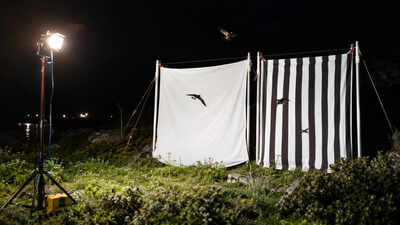
Researchers in Canada have found that changing the colour or pattern of a surface could help prevent seabirds from crashing into illuminated structures at night. In experiments conducted during 2024 and 2025 on Bon Portage Island in Nova Scotia, scientists found that Leach’s Storm-Petrels were less likely to collide with dark or patterned sheets than with plain white ones. Vertically striped sheets recorded 2.8 times fewer bird collisions than plain sheets. The findings were published in the journal Ornithological Applications, Oxford University Press reported.The study examined a problem affecting seabirds that travel or search for food at night. Artificial lights from coastal buildings, fishing vessels and offshore industrial facilities can disturb their movements. Some birds become stranded near these lights, while others collide with structures. Such incidents can cause injuries or leave birds exposed to exhaustion, dehydration and predators.Turning off lights can reduce these risks, but it is not always possible. Ports, industrial sites and other workplaces often need lighting to protect workers. Researchers therefore wanted to know whether changing the appearance of walls and other upright surfaces could make them safer for birds without requiring the lights to be switched off.The team, comprising Alina Rutherford, Michael Robertson, Linda Hutchinson and Dave Shutler, tested this idea in a breeding colony of Leach’s Storm-Petrels. The species, scientifically known as Hydrobates leucorhous, is classified as vulnerable globally. Bon Portage Island is home to around 39,000 breeding pairs, making it the largest colony of the species in Nova Scotia.
How researchers tested colours and patterns
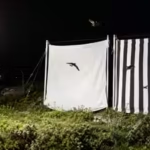
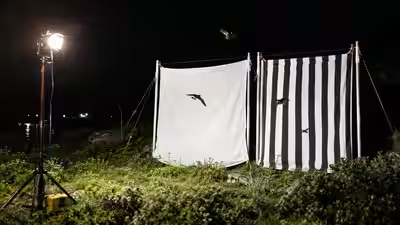
The experiments took place over 40 nights across two years. In 2024, researchers tested different colours over 28 nights between July and September. The following year, they examined patterns over another 12 nights between June and August.They suspended cloth sheets measuring approximately 2.3 metres by 2.6 metres from poles inside the colony. The sheets acted as substitutes for walls or other vertical surfaces that birds might encounter near artificial lighting.During the first year, the team used white, beige and black sheets. These colours were selected to compare how much light each surface reflected and to represent colours commonly found on buildings.In 2025, the researchers used plain white sheets alongside sheets marked with vertical stripes or grid patterns. Black fabric paint covered approximately half of each patterned sheet.Floodlights illuminated the sheets, switching on and off at five-minute intervals. Researchers changed the sheet being tested every 30 minutes and recorded how many birds collided with it.The experiment was designed to avoid harming the birds. If a bird repeatedly struck a sheet, researchers temporarily switched off the light. Birds that remained in the area were moved to a dark location.
What the experiments revealed
The results showed a strong connection between artificial lighting and collisions. Storm-petrels were approximately nine times more likely to strike the sheets when the lights were switched on than when they were off.Colour also made a difference. White sheets recorded 2.7 times more individual bird collisions than black sheets. The white material reflected almost five times as much light as the black material.Patterns produced another important result. Compared with plain sheets, those marked with grids recorded 2.4 times fewer individual bird collisions, while vertically striped sheets recorded 2.8 times fewer.When researchers counted every collision, including repeated strikes by the same bird, the differences were even greater. Grid-patterned sheets recorded 3.4 times fewer total collisions, while striped sheets recorded 3.7 times fewer.The findings suggest that darker surfaces and visible patterns could make illuminated structures less dangerous for seabirds.
Why artificial light may confuse seabirds
Researchers also observed something unexpected. Although more birds collided with sheets when the lights were on, fewer birds appeared to be flying overhead during illuminated periods.When the lights were switched on, birds flying above the experimental area often scattered. This suggested that artificial light might not simply attract birds at close range.Instead, the researchers said the light could be interfering with their ability to recognise and avoid nearby objects.The exact reason remains uncertain. Artificial lighting may interfere with visual or navigational signals, or its brightness may temporarily affect the birds’ vision.
Could changing wall colours save seabirds?
The researchers believe darker or patterned walls could offer a practical way to reduce collisions at coastal facilities, ships and offshore platforms.Patterns may be particularly useful where lighting must remain bright for worker safety. In the experiment, patterned sheets reduced collisions even when the overall amount of reflected light was approximately equal to that of plain sheets.However, the team cautioned that the method has so far been tested inside a breeding colony, not at industrial locations where seabirds become stranded.Further research is needed to establish whether changing real building surfaces would produce similar results and whether the approach could protect birds without compromising human safety.