


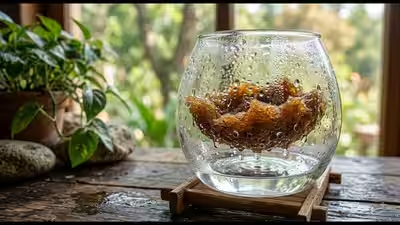
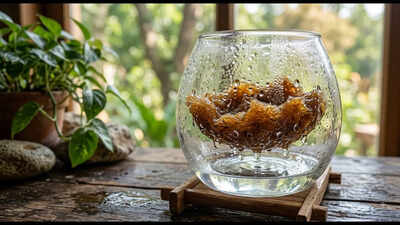
What if food scraps, discarded branches and seashells could help produce drinking water from the air? Researchers at the University of Texas at Austin have developed a new class of biomass-based hydrogels that can capture atmospheric moisture and release it as clean water using relatively mild heat. The approach, described in the peer-reviewed journal Advanced Materials by Weixin Guan, Yaxuan Zhao, Chuxin Lei, Yuyang Wang, Kai Wu and Guihua Yu, could offer a more sustainable route to atmospheric water harvesting. Rather than relying on a single specialised synthetic material, the researchers developed a molecular engineering strategy that can transform natural polysaccharides such as cellulose, starch and chitosan into water-absorbing hydrogels. In outdoor testing, the cellulose-based material produced up to 14.19 kilograms of water per kilogram of sorbent per day under the tested conditions. The work, published as ‘Molecularly Functionalized Biomass Hydrogels for Sustainable Atmospheric Water Harvesting’, points towards portable water harvesters and decentralised systems that could operate in places where conventional water infrastructure is difficult to build.
Meet the University of Texas researchers turning food scraps and seashells into materials that harvest water from thin air
The central idea behind the research is surprisingly simple: instead of searching for one perfect material that can absorb moisture from the atmosphere, the team developed a molecular strategy for converting many naturally abundant biomass materials into effective sorbents. In their Advanced Materials paper, Guan, Zhao, Lei, Wang, Wu and Yu describe hydrogels based on natural polysaccharides including cellulose, starch and chitosan. These materials were chemically modified to give them two important characteristics, the ability to attract and hold water molecules, and the ability to release captured water when heated. The researchers reported that their molecularly functionalised cellulose hydrogel could capture between 0.86 and 1.32 grams of water per gram of material at relative humidities of 15-30%, while 95% of the captured water could be released at 60°C.The significance is that biomass becomes more than waste or an agricultural by-product. Cellulose, starch and chitosan are widespread natural polymers, meaning the starting materials for these sorbents can potentially come from inexpensive and renewable sources. The University of Texas at Austin says the broader approach can encompass discarded food scraps, branches, seashells and other natural materials. Rather than requiring each source material to be individually engineered for a particular application, the researchers’ strategy is designed to introduce the molecular properties needed for atmospheric water harvesting across different biomass feedstocks.
How the biomass hydrogel captures invisible moisture and turns it into usable water
Atmospheric water harvesting works by exploiting something that is almost everywhere, even though it may be difficult to see: water vapour. Air continuously contains varying amounts of moisture, but extracting that moisture efficiently becomes much harder when humidity falls. A useful sorbent therefore needs to capture water molecules even when the surrounding air is relatively dry, then release them without requiring so much energy that the process becomes impractical.The Texas team’s hydrogel tackles those two stages through molecular engineering. According to the study, the researchers first grafted thermoresponsive groups onto the natural polysaccharide backbone through alkylation. They then incorporated zwitterionic groups that improve the material’s ability to absorb water. The resulting molecular architecture allows the hydrogel to absorb atmospheric moisture while also making it easier to release the captured water at comparatively low temperatures.That second part is particularly important. Capturing water is only half of an atmospheric water-harvesting system. The moisture has to be removed from the sorbent and collected as liquid water before the material can be used again. In the laboratory experiments reported in Advanced Materials, the cellulose hydrogel released 95% of its captured water at 60°C. Because the required release temperature is relatively modest, the researchers argue that the system can reduce the energy burden associated with regenerating the sorbent.The team subsequently tested the material outside the laboratory. During outdoor experiments, the researchers achieved a water production rate of up to 14.19 kilograms per kilogram of sorbent per day using electrical heating. The University of Texas notes that conventional sorbents commonly produce around 1–5 litres of water per kilogram per day, placing the reported result considerably above that range under the tested conditions.
Why turning waste biomass into water-harvesting material could matter
The environmental appeal of the technology comes from both ends of the process. Conventional sorbents can depend on synthetic or petrochemical-derived materials, while the Texas approach starts with biomass-based polysaccharides. The authors describe their strategy as a way of expanding the range of raw materials available for sorbent production by using abundant biomass feedstocks. The University of Texas also describes the resulting materials as biodegradable and potentially scalable.That does not mean every piece of organic waste can simply be placed into the system and immediately produce drinking water. The biomass must first contain an appropriate polysaccharide structure or be processed into a suitable material, after which molecular functionalisation gives it the properties required for moisture capture and release. The innovation lies in making this conversion more general rather than developing a completely different sorbent for every source material.The approach could also be useful because atmospheric water harvesting does not depend on a river, lake or underground aquifer being nearby. A system can potentially operate wherever there is moisture in the atmosphere. That makes the technology particularly interesting for decentralised water supplies, remote communities and emergency situations. The UT Austin team says it is now working on scaling production and developing real-world systems, including portable water harvesters, self-sustaining irrigation systems and emergency drinking-water devices.Still, the reported laboratory and outdoor results should not be confused with a fully commercial water supply. Real-world deployment would have to account for changing humidity, temperature, heating requirements, collection efficiency, material durability and the cost of producing and maintaining the sorbent. Scaling a promising material into a dependable water system is a separate engineering challenge.
From food waste to off-grid water systems: where the technology could go next
The researchers are ultimately interested in moving atmospheric water harvesting beyond laboratory demonstrations. Guihua Yu, the study’s corresponding author and a professor in materials science and mechanical engineering at UT Austin, described the work as a new strategy for transforming diverse natural materials into high-efficiency sorbents. Weixin Guan, the study’s lead researcher, similarly emphasised the potential of using abundant natural resources to make water from atmospheric moisture. Those comments were published by the University of Texas at Austin alongside the research announcement.The possible applications are therefore broader than simply producing a bottle of water. A portable atmospheric water harvester could potentially provide an additional source of drinking water in remote locations. Larger systems could be designed for decentralised communities that lack conventional water infrastructure. The researchers have also identified irrigation as a potential application, where atmospheric moisture could supplement rather than replace conventional water sources. Emergency relief is another possibility, particularly where disasters damage pipelines or other water infrastructure.The idea also fits into a longer research programme at UT Austin focused on using hydrogels to address water scarcity. Earlier work from Yu’s group explored molecularly engineered hydrogels capable of extracting atmospheric moisture using solar energy, while other research from the group has investigated hydrogel-based water filtration.The new biomass strategy represents a further step towards making those concepts more sustainable and adaptable. Instead of treating water harvesting and waste reduction as completely separate problems, the researchers have connected them through material science: abundant biological materials can be chemically redesigned into sorbents that capture water vapour, and relatively mild heat can then recover the water.The research by Guan, Zhao, Lei, Wang, Wu and Yu, published in Advanced Materials, does not suggest that atmospheric water harvesting will replace conventional water infrastructure overnight. What it demonstrates is more specific, and potentially more useful. A broad range of biomass materials can be molecularly engineered into efficient water-harvesting hydrogels, and the resulting material can extract substantial quantities of water under tested conditions. If the researchers can scale the material and build efficient devices around it, tomorrow’s emergency water harvester could have an unusual origin: something that began as food waste, plant material or another discarded piece of biomass, transformed into a material capable of pulling water out of the air.