





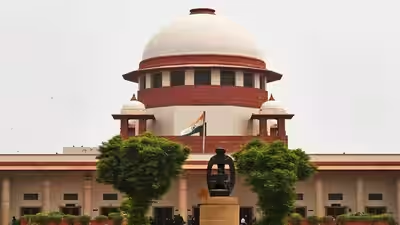
The Supreme Court will hear on August 21 a plea seeking directions to the Centre and the Central Board of Secondary Education (CBSE) to frame clear regulations for conducting board examinations through the On-Screen Marking (OSM) system.The matter assumes significance as concerns have been raised over the impact of the digital evaluation process on students’ marks and, consequently, their admissions to higher education courses.
Supreme Court takes up concerns over CBSE digital evaluation
The plea was heard on Friday by a bench comprising Chief Justice of India Surya Kant and Justices Joymalya Bagchi and V Mohana.During the hearing, the petitioner’s counsel told the court that some students had cleared their CBSE examinations but later faced difficulties in securing admission to other courses because their board examination scores did not meet the required cut-offs.According to the counsel, some of these students had already appeared for entrance examinations and certain courses have also begun.The bench, while hearing the matter, asked the counsel representing the CBSE to examine how the interests of such students could be protected.The hearing was then deferred to August 21 after the court was informed that Solicitor General Tushar Mehta, who had earlier been asked to assist the court, was unavailable on Friday.
What is CBSE’s On-Screen Marking system?
Under the On-Screen Marking system, physical answer sheets are scanned and made available digitally to evaluators. Teachers then check and award marks on a computer rather than assessing the original paper copies manually.The system is intended to bring greater efficiency and standardisation to the evaluation process. However, concerns have been raised over discrepancies in marks and the manner in which students’ answer scripts are assessed digitally.The case before the Supreme Court seeks to address these concerns at a broader level and establish safeguards for students undergoing evaluation through the system.
Supreme Court had earlier sought Centre’s response
The Supreme Court had previously taken note of concerns raised by students regarding the digital marking system. On July 15, the court expressed concern over the “frustration” among students and sought the assistance of Solicitor General Tushar Mehta.The Solicitor General had informed the court that several individual complaints relating to marksheets had largely been resolved. At the same time, he indicated that the government was examining the broader issues associated with the evaluation process.A one-member commission headed by S Radha Chauhan has also been constituted to review the existing evaluation system and suggest systemic improvements.The court had asked the Solicitor General to provide details of the corrective measures undertaken by the CBSE so far.
Plea seeks safeguards for affected students
The Public Interest Litigation (PIL) has been filed by Rakesh Binjola through advocate Laxmikant Matadan Shukla.Apart from seeking regulations governing the OSM-based evaluation process, the plea calls for the creation of a high-powered committee to oversee and implement reforms in the system.The petitioner has also sought relief for students who may have been affected by their CBSE marks after securing provisional admission or qualifying in entrance examinations.One of the key demands is relaxation in minimum qualifying marks for such students. The plea has also sought exemption from the 75 per cent or other prescribed Class 12 marks requirements in cases where students have already secured provisional admission or cleared relevant entrance examinations.
August 21 hearing could determine next course
The August 21 hearing is expected to provide further clarity on the steps being considered by the CBSE and the Centre to address concerns surrounding the OSM evaluation system.For students whose admissions or academic progression may have been affected by their board scores, the proceedings could be significant. The court’s consideration of the broader evaluation mechanism may also determine whether additional safeguards or regulatory measures are required for future CBSE examinations.(With inputs from PTI)