




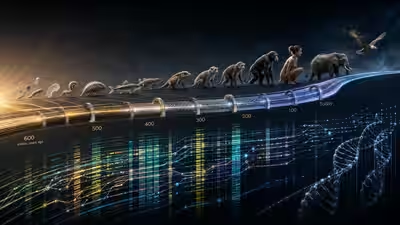
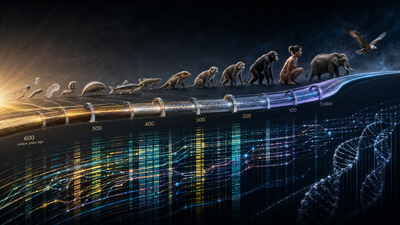
Scientists have traced hidden pathways through animal evolution by comparing thousands of genomes and following pieces of chromosomes that have survived for hundreds of millions of years. The study examined 5,821 chromosome-scale genomes from 4,454 species across 19 animal phyla, using 29 ancient linkage groups as markers of chromosome history. Every one of the 406 possible pairings between those ancestral groups appeared somewhere in the dataset, showing how often chromosomes have been joined and reshaped during animal evolution. The resulting genome maps reveal distinct evolutionary trajectories, with some animal groups retaining much of their ancient chromosome structure while others underwent extensive rearrangement.The pace of these changes also varied through time, with chromosome fusions becoming particularly active around 550 million years ago before slowing later. Together, the findings show how ancient chromosome changes can persist, accumulate and influence the routes taken by animal genomes over deep evolutionary time.
How ancient chromosomes shaped 600 million years of animal evolution
According to the study published in Science Advances, titled ‘Topological mixing and irreversibility in animal chromosome evolution’, chromosomes have been repeatedly fused, split and rearranged. Parts of the chromosome arrangement found in an ancient animal ancestor can still be recognised today. The researchers describe 29 ancestral linkage groups, or ALGs, as remnants of those ancient chromosomes. They used 2,361 gene families that are conserved across animals as markers, allowing them to follow pieces of chromosome history even where whole-genome sequence comparisons become unreliable over such vast evolutionary distances.Once those markers were placed across thousands of genomes, the scale of the pattern became clearer. There are 406 possible pairings among the 29 ancestral linkage groups, and every one of those pairings appeared somewhere in the dataset, either as a straightforward fusion or as a fusion followed by further mixing. That does not mean every animal has travelled down the same route. Cnidarians, for example, tend to preserve the ancient chromosome units, while nematodes show much more extensive rearrangement and chromosome contraction. The researchers therefore see genome history less as a single path and more as a branching set of routes shaped by what happened to chromosomes along each lineage.
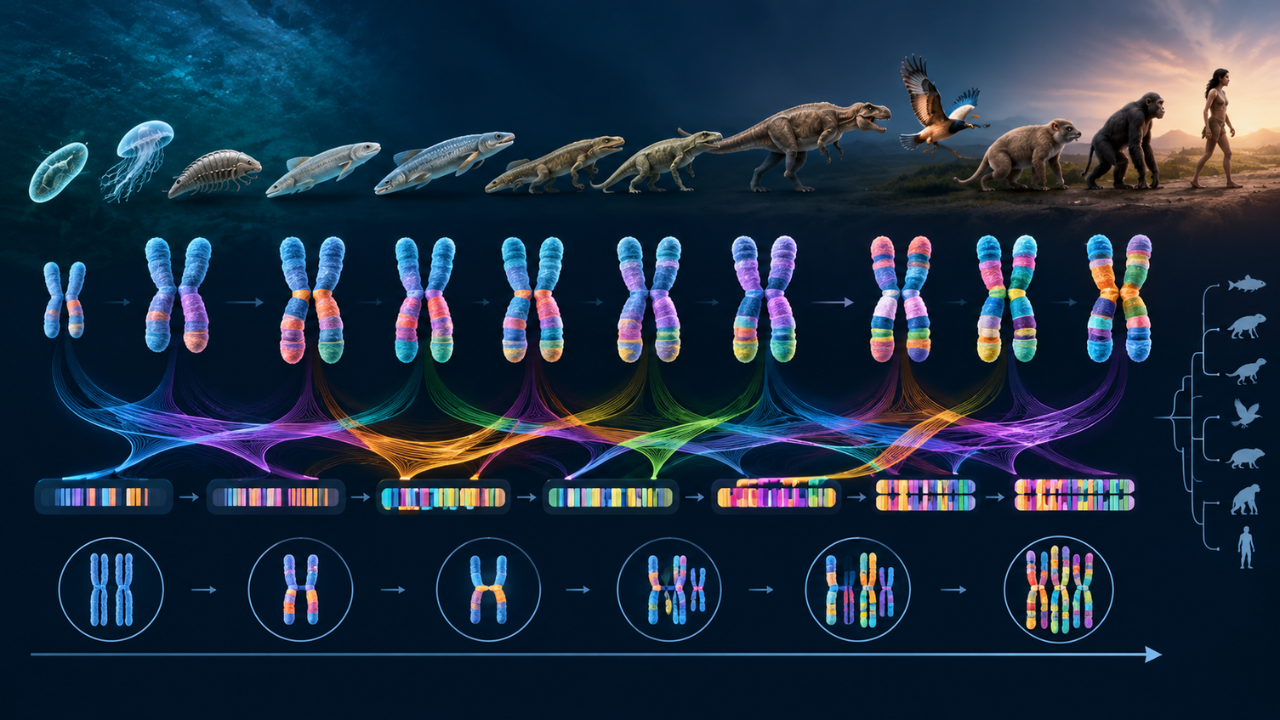
Image AI generated
Why different animal lineages occupy distinct evolutionary genome pathways
The team then developed what it calls “evolutionary genome topology”, a way of comparing chromosome organisation at several scales at once. Instead of simply asking whether two genes are present, the method considers how far apart conserved genes are and whether they occupy the same chromosome. Those relationships can then be projected into a visual map using techniques including UMAP. Genomes with similar organisational histories tend to sit near one another, while lineages that have followed different rearrangement histories form separate clusters and branches.That produced something resembling a map of evolutionary routes. Chordates, Diptera, Hymenoptera, Schistosoma and several lepidopteran groups each form recognisable trajectories, while highly rearranged groups such as mosquitoes, fruit flies and nematodes occupy more derived regions. The pattern was not simply a reflection of how scrambled a genome had become: distantly related animals with extensive rearrangements did not collapse into one generic endpoint. Their positions remained distinct, suggesting that different groups had reached their present chromosome arrangements through different histories.
How chromosome fusion rates changed across 600 million years of animal evolution
The history revealed by the genomes is also uneven in time. Chromosome fusion became particularly active towards the end of the Ediacaran, around 550 million years ago, with the average rate reaching about 0.25 fusions per million years. That rate subsequently fell, reaching roughly 0.01 fusions per million years by the Jurassic. Dispersal, in which genes move away from their ancestral chromosome through interchromosomal translocations, followed a different pattern and was generally less frequent than fusion for much of the Phanerozoic.The changes were not spread evenly across the animal tree either. Some branches show relatively conservative chromosome histories, while others underwent bursts of rearrangement. Arthropods, for instance, experienced a period of elevated fusion and dispersal around the beginning of their diversification in the Cambrian, after which the pace slowed. In mosquitoes and some clitellate annelids, the changes appear to have happened so quickly that closely related genomes no longer preserve enough intermediate states to reconstruct the rate confidently. The researchers describe these episodes as saltatory changes rather than a steady background process.
How 2,361 conserved gene families reveal lasting chromosome changes
A chromosome fusion does not fix a genome’s structure forever. Once two ancestral chromosomes join, inversions can gradually shuffle their sections, moving genes into new neighbourhoods. The study calls this “fusion-with-mixing”. Smaller chromosomes can become heavily mixed after relatively few inversion cycles, while larger ones take longer to reach the same level of change.Some of these new gene arrangements can then persist for long periods. The researchers call these stable patterns “entanglements”, which may bring genes and regulatory elements into closer proximity than before. Whether such arrangements are actively maintained by selection remains unclear.This means ancient chromosome changes can continue to influence genome evolution long after the original fusion. The study tracked 2,361 deeply conserved gene families across thousands of genomes, although this represents only a fraction of the genes in a typical animal genome. Even with that limitation, the analysis shows how old chromosome changes can create lasting evolutionary paths and distinct genome architectures across animal groups.