





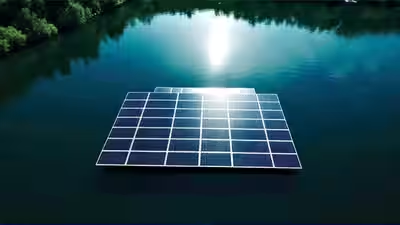
Looking to post solar energy generation capacity, Prime Minister Narendra Modi-led cabinet on Friday approved the Pradhan Mantri Surya Sarovar Yojana (PM-SSY) scheme. The scheme targets establishing 5,000 MW of Floating Solar PV (FSPV) capacity in the country.This is a more than seven-fold increase over the nearly 700 MW installed today, IT minister Ashwini Vaishnaw said. The scheme has been approved for a period of 5 years. It will support up to Rs 1 crore per MW under the scheme with total outlay of Rs 5070 crore.FSPV projects will include a minimum of 2-hour Energy Storage Systems (ESS), totalling 10,000 MWh which will help states manage peak demand, the minister said. The projects will be selected through tariff-based competitive biddingUnder the scheme, eligible floating solar photovoltaic projects will receive Central Financial Assistance (CFA) of Rs 1 crore per MW after they are successfully commissioned, according to an official statement.The scheme also provides CFA of Rs 50 lakh for carrying out feasibility studies, including bathymetry and hydrography surveys, environmental assessments and other preparatory work.
Benefits of Floating Solar Photovoltaic
The government listed the following benefits of the scheme:
- No additional land acquisition required
- Will create an opportunity to productive use of existing reservoirs, canals and industrial ponds for
solar power generation - Will lower dust levels on the solar panel, meaning fewer soiling losses, reduced cleaning costs and higher sustained generation efficiency
- Will significantly reduces evaporation from the host water body, conserving water for irrigation, industry and drinking supply
- Will open up solar capacity in states that are constrained on land but have large reservoirs and water bodies available
According to the statement, PM-SSY seeks to establish 5,000 MW of floating solar photovoltaic capacity along with co-located energy storage systems capable of providing a minimum of two hours of storage, equivalent to 10,000 MWh.Projects under the scheme will be approved between FY2026-27 and FY2030-31, while the financial assistance will continue to be disbursed until FY2032-33.The scheme will cover all states and Union Territories. It is expected to increase India’s floating solar PV capacity by 5,000 MW from the current level of about 700 MW. By utilising existing reservoirs and industrial ponds, the projects will make productive use of available water bodies while avoiding competition for limited land resources.The inclusion of energy storage systems is expected to improve grid reliability. The scheme is also projected to cut carbon dioxide emissions by around 10 million tonnes annually and generate nearly 16,000-17,000 full-time equivalent jobs across the project value chain.The statement said the initiative has the potential to unlock 102 GW of floating solar capacity.It added that the scheme will encourage domestic manufacturing of flotation systems as well as other components across the project value chain, including PV cells, modules and energy storage systems, while supporting the vision of Aatmanirbhar Bharat.Official data showed that India’s installed solar power capacity rose from 2.82 GW in March 2014 to 150.26 GW in March 2026, an increase of 147.44 GW. Floating solar accounted for around 700 MW of this capacity.