





Jurassic World was not silent. Around 165 million years ago, forests in present day Inner Mongolia were filled with the calls of insects communicating through sounds that ranged from low tones to frequencies beyond human hearing. Now, biologist Thorin Jonsson and an international team have used exceptionally preserved fossil wings to reconstruct part of that ancient soundscape. Their research provides a rare opportunity to investigate how extinct animals may have communicated. By examining sound-producing structures preserved in the wings of ancient insects, the scientists reconstructed features of their mating calls and identified a diverse range of sounds within a single Jurassic ecosystem. The research, published in PNAS, also revealed evidence that one insect species may have used ultrasonic communication long before bats evolved, offering a unique insight into the complexity of life in a prehistoric forest.
How did Thorin Jonsson use ancient insect wings to recreate Jurassic sounds
Reconstructing the sounds of extinct animals is difficult because the soft tissues involved in producing them rarely survive. Insects offer an exception because some species create sounds using specialised structures on their hardened wings. According to the study titled ‘Reconstruction of an extinct soundscape reveals ultrasonic communication in the Jurassic,’ these structures can include a file-like section with tiny teeth that rub against another part of the wing, producing vibrations. Because these features can be preserved as fossils, they can provide evidence of sounds made millions of years ago. The researchers examined 20 fossils representing 9 species of long-horned insects from the ‘Middle Jurassic Jiulongshan Formation’ in Inner Mongolia. They combined evolutionary analysis, vibration measurements, computer simulations and an AI-based approach to reconstruct features of the insects’ calls. The University of Graz in Austria reported that the exceptional preservation of the fossils allowed the team to study these tiny sound-producing structures in detail. Their work provided estimates of both the pitch and basic repeated patterns of the ancient mating calls.
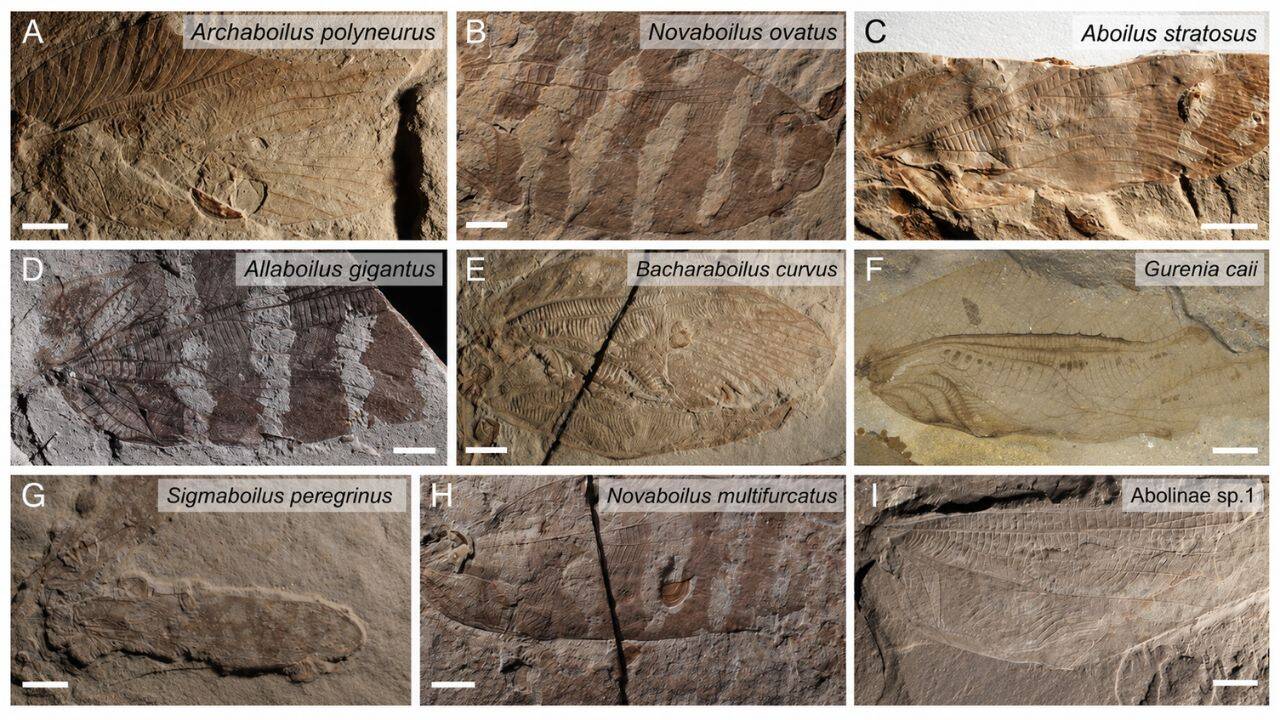
(A–I) Examples of fossilized wings of the nine species presented in this study. Image Credit: PNAS
The fossils revealed diverse Jurassic sounds
The nine species did not produce identical sounds. According to the research study, differences in their wing structures and sizes created a variety of call frequencies and patterns. Some insects produced lower, purer tones, while others made higher-frequency sounds. The University of Graz reported that certain reconstructed calls resembled the ‘low tones of modern crickets,’ whereas others were closer to the higher sounds associated with some present-day ‘grasshoppers.’ These differences may have helped the insects communicate with potential mates while living alongside other species in the same environment. The study also suggests that ‘pure-tone calls’ could have reduced the risk of being easily located by predators that relied on sound to find prey.
Ultrasonic calls may have evolved in insects long before the first bats appeared
The most surprising finding involved evidence of ‘ultrasonic communication’ in one fossil species. The researchers found that its call may have exceeded 20 kilohertz, placing it above the normal range of human hearing. According to the University of Graz, this suggests that ultrasonic communication appeared in insects around 100 million years before the evolution of bats. The researchers explored how such sounds may have developed and suggested that interactions between singing insects and predators with increasingly sophisticated hearing could have shaped their evolution. This would have created a long-running evolutionary pressure involving both the production and detection of sound.
Small wings are changing how scientists study the past
The research forms part of the ‘Small Wings, Loud Songs’ project, supported by the Austrian Science Fund and involving researchers from Austria, the UK, China and the United States. Its importance lies in ‘what the fossil wings can reveal beyond the appearance of extinct insects.’ Their preserved structures contain evidence of behaviour that would otherwise be impossible to study. The scientists cannot reproduce the Jurassic forest exactly as it sounded, but the fossils provide scientifically grounded clues about one part of its acoustic environment. Features only millimetres wide have allowed researchers to investigate how insects communicated 165 million years ago.For Thorin Jonsson and his colleagues, these ancient wings have opened a unique window into prehistoric life. They show that even after millions of years, fossils can preserve traces of something as fleeting as sound.