






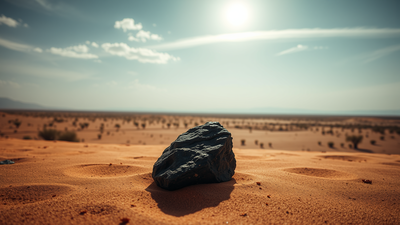
For years, a meteorite lay in the deserts of north-west Africa, seemingly no different from countless other rocks scattered across the landscape. Yet hidden inside it was a record of one of the Moon’s most violent eras, a geological story that had remained untold for more than three billion years.The meteorite, known as Northwest Africa (NWA) 12593, was discovered in Mali in 2017 before making its way into scientific collections. What initially appeared to be a routine lunar meteorite has since revealed something far more intriguing. Detailed analysis suggests it preserves evidence of a previously unknown impact event that struck the Moon around 3.5 billion years ago, at a time when the Solar System was still settling into its modern form.For planetary scientists, discoveries like this are exceptionally rare. Unlike rocks collected directly from the Moon during the Apollo missions, lunar meteorites can originate from virtually anywhere on the lunar surface. They often carry fragments of regions humans have never visited, acting as messengers from unexplored corners of our celestial neighbour.
Rare lunar rock preserves evidence of three ancient collisions on the Moon
NWA 12593 is classified as a lunar fragmental regolith breccia, a rock created when repeated impacts shatter and fuse lunar material over immense spans of time. Embedded within the meteorite are fragments of basalt, granulites, impact-melt breccias and minerals such as zircon, olivine and pyroxene, all compressed into a geological patchwork.Researchers from the Department of Geological Sciences, University of Colorado Boulder, studying the sample found evidence that it had endured at least three major impact events throughout its history. The oldest appears to date back roughly 3.5 billion years and was powerful enough to generate extreme temperatures across part of the lunar crust.One of the most significant clues came from the presence of recrystallised cubic zirconia, a mineral structure that forms only under intense heat. Its existence suggests that parts of the Moon’s surface may have briefly melted during the event, leaving behind traces that survived long after the original crater itself was altered or erased.Lead author Carolyn Crow, a planetary scientist at the University of Colorado Boulder, highlighted the significance of the period in the study titled ‘Three-body evidence of ca. 3.7 Ga to 3.2 Ga bombardment across the inner solar system,’ the researchers briefly talk about the period in which the impact occurred:“On Earth, the first fossil evidence of life shows up around 3.5 billion years ago, meaning that life is emerging and evolving before then.”That overlap makes the discovery especially compelling. While the impact itself occurred on the Moon, it unfolded during a chapter of Solar System history that also witnessed some of Earth’s earliest biological developments.
New study links a massive lunar impact to a turbulent period across the early Solar System
The meteorite’s story did not end with a single collision. Scientists believe subsequent impacts altered the rock again, generating additional melting before a final, powerful strike eventually blasted the fragment away from the lunar surface and into space.After drifting through the Solar System for millions of years, it ultimately fell to Earth, where it landed in the African desert and remained undiscovered until recent years. The journey is extraordinary even by meteorite standards. Every stage, from its formation on the Moon to its arrival on Earth, is recorded within its minerals like pages in an ancient archive.What excites researchers most is the possibility that the newly identified impact was not an isolated event. Similar evidence for major collisions has been observed in rocks from other bodies across the Solar System, including Earth and the asteroid Vesta. This raises the possibility that several planetary worlds experienced a period of heightened bombardment around the same time.Tracing events that occurred billions of years ago is notoriously difficult. Planetary surfaces change, craters erode and geological processes erase evidence. The Moon is often better at preserving ancient history than Earth, yet even there many early records have been obscured by later impacts.That is what makes NWA 12593 so valuable. Rather than preserving a single moment, it captures multiple episodes from the Moon’s deep past. Each mineral grain, fracture and melted fragment offers another clue about how the lunar surface evolved and how the wider Solar System endured an age of relentless collisions.Scientists hope further analysis will reveal even more. For now, a meteorite once overlooked in the sands of north-west Africa has become an unexpected window into a turbulent era that shaped worlds across the Solar System, including our own.