

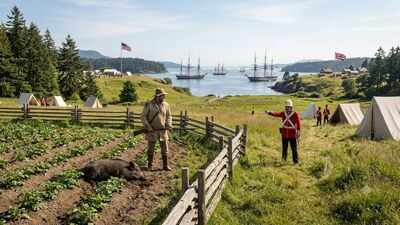
In 1859, a single pig turned a quiet island dispute into a tense confrontation between two powerful nations. What began as a farmer’s frustration over a wandering animal on San Juan Island quickly escalated into a military standoff involving British warships, American soldiers and competing territorial claims. The disagreement was rooted in a much older problem; an unclear boundary created by the 1846 Oregon Treaty. For 12 years, Britain and the United States maintained rival camps on the island but avoided open conflict. Known as the Pig War, the unusual crisis was eventually resolved through diplomacy and arbitration, leaving behind one of history’s strangest border disputes.
How the 1846 Oregon Treaty created a territorial dispute over the San Juan Islands
As reported by the National Park Service (NPS), the roots of the dispute stretched back to 1846, when Britain and the United States signed the Oregon Treaty to settle competing claims in the Pacific Northwest. The agreement placed the boundary between the two countries along the 49th parallel, but its wording created a problem.The treaty referred to a channel separating the mainland from Vancouver Island before the boundary continued westward. The difficulty was that there was more than one possible interpretation of that description. The Haro Strait and the Rosario Strait both matched parts of the wording, but they followed different routes.The San Juan Islands sat between these waterways, leaving both Britain and the United States convinced they belonged to them. At the time, the islands were not a major settlement centre. Their value came from their location, fertile land, and access to resources. The Hudson’s Bay Company, a powerful British trading organisation operating from Fort Victoria on Vancouver Island, moved early to strengthen its position.Reportedly, by 1851, the company had established salmon-processing operations on San Juan Island. Two years later, it created Belle Vue Sheep Farm on the island’s southern end, partly as a commercial venture and partly as a statement of British interest in the territory.
Rising tensions over the San Juan Island land dispute
As reports about the island’s fertile land reached American communities, settlers began arriving. By 1859, several Americans had claimed areas that were already being used by the Hudson’s Bay Company for grazing.The settlers believed their claims were legitimate under American law. British officials saw them differently, considering them unauthorised occupants on British territory.There was no clear authority controlling everyday disputes on the island. A disagreement over land, animals, or property could quickly become a political argument because neither side accepted the other’s legal rights.The atmosphere became increasingly tense. The British continued to support the Hudson’s Bay Company’s activities, while American settlers looked towards the United States government for protection. Then came the incident that gave the confrontation its unusual name.
A pig turns into an international crisis
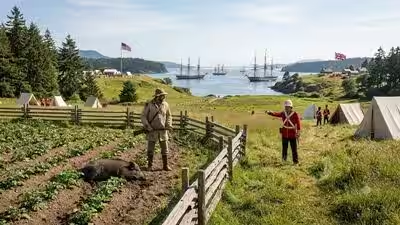
On 15 June 1859, American settler Lyman Cutlar discovered a pig repeatedly damaging his garden. The animal belonged to the Hudson’s Bay Company. After earlier complaints failed to solve the problem, Cutlar shot the pig.On San Juan Island, it became a question of authority. British officials threatened legal action against Cutlar and warned that American settlers could be removed as trespassers. The settlers appealed for military support from Brigadier General William S. Harney, commander of the US Army’s Department of Oregon. Harney responded by sending troops.Captain George E. Pickett, who would later become a Confederate general during the American Civil War, arrived on San Juan Island in July 1859 with a company of US soldiers. His force established a camp near the Hudson’s Bay Company’s property.
The San Juan Island dispute turns into a military standoff
News of the American military presence angered James Douglas, governor of Vancouver Island. He ordered the British navy to remove the soldiers if necessary, though he instructed commanders to avoid violence.Captain Geoffrey Phipps Hornby arrived aboard HMS Tribune, a British steam frigate, and was soon joined by additional ships, including HMS Satellite and HMS Plumper. The situation began to resemble a military confrontation. Troops gathered, weapons were positioned with both sides prepared for the possibility of conflict.Rear Admiral Lambert Baynes, commander of British naval forces in the Pacific, was particularly opposed to escalation. After reviewing the situation, he reportedly dismissed the idea of a major conflict over what had started as a dispute involving a single pig.
The Pig War’s unusual standoff between rival armies
Despite the tension, life on San Juan Island during the crisis had a strange normality. American forces expanded their position, and by the end of August hundreds of soldiers were stationed on the island with artillery support. Engineers built defensive positions, while British forces conducted their own military exercises nearby.The two sides had enough weapons to cause serious damage. The British had dozens of guns available, while the Americans strengthened their camp with additional artillery brought from naval vessels. But the expected battle never came.Instead, British and American officers often interacted peacefully. They attended religious services together, exchanged conversations, and shared meals and drinks. Visitors arriving from nearby Victoria even treated the military standoff as a curiosity. The island had become a place where two nations displayed their strength without actually using it.
The peaceful negotiations that ended the Pig War standoff
When news of the confrontation reached officials in Washington, the reaction was very different from the atmosphere on the island. Leaders feared the dispute could damage relations between Britain and the United States.President James Buchanan sent General Winfield Scott, the senior commander of the US Army, to investigate and negotiate a solution. Scott had previously helped settle tensions along other disputed borders.After arriving in October 1859, Scott worked with British officials to reduce the military presence. Both countries agreed to leave only a small number of forces behind while they searched for a permanent settlement. The Americans remained at what became known as American Camp, while British Royal Marines established English Camp on the island’s northwestern side in 1860.
How the San Juan Islands dispute was settled without a battle
The two military camps remained on San Juan Island for the next twelve years. During that period, British and American soldiers lived only a short distance apart but maintained peaceful relations.The island became a rare example of two rival powers occupying the same territory without fighting. The final answer came through international arbitration. In 1871, Britain and the United States signed the Treaty of Washington, which sent the San Juan boundary question to Kaiser Wilhelm I of Germany.The Kaiser referred the matter to a three-member commission that met in Geneva. After months of discussion, the commission ruled in favour of the United States on 21 October 1872.The boundary was drawn through the Haro Strait, placing the San Juan Islands under American control.
End of the pig war
British forces left English Camp in November 1872, and the remaining American troops departed in 1874. After years of uncertainty, the island finally had a confirmed national identity.The conflict became known as the Pig War because the only recorded casualty was the animal that started the dispute.Behind the unusual name was a serious diplomatic challenge involving unclear borders and competing ambitions. The outcome was decided not by weapons, but through negotiation and arbitration leaving San Juan Island remembered less for a battle than for a crisis that never became one.