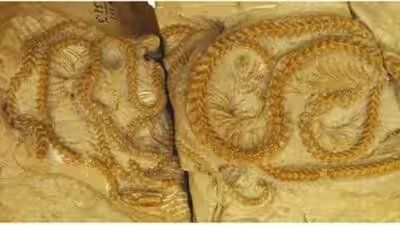
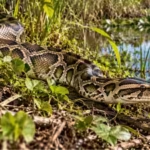


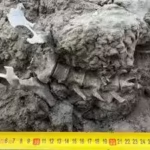


Scientists discovered four snakes curled together in a burrow for 38 million years as the volcanic ash preserved their remarkable fossils |

Overview of Hibernophis breithaupti (UW11120 on two blocks), showing holotype (UW-11120-A) and paratype (UW-11120-B) specimens as exposed on the surface. Image Credit: Zoological Journal of the Linnean Society A snake fossil discovery in Wyoming has given palaeontologists an unusually close look at the lives of these ancient reptiles. Four complete skeletons belonging to a newly…

Read More

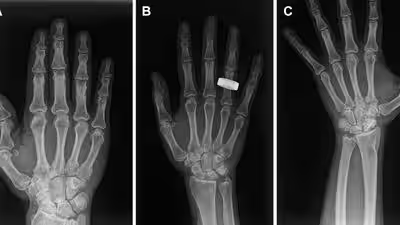
For the first time in history, astronauts use portable X-ray technology in space that could pave the way for future Moon and Mars missions |

Representative preflight, in-flight, and post-flight hand radiographs. Radiographs of the hand were acquired (A) preflight by a crew member, (B) in-flight on day 1 after launch (L+1) by a crew member, and (C) post-flight by a non-crew operator using the same imaging protocol. Image Credit: Radiological Society of North America(RSNA)​ The first X-rays taken in…

Read More

US-Iran war brings Air India Group’s international carriage down 35%, IndiGo’s 15.4%

US-Iran war hits Indian carriers harder as international passenger traffic falls 26% NEW DELHI: The US-Iran war’s impact on international air travel globally has, from an Indian perspective, hit homegrown carriers harder than foreign ones.While people flying in and out of India fell 10.5% to 1.7 crore during April-June, the traditional peak summer quarter, Indian…

Read More

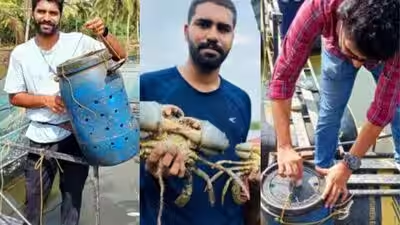
Two Kochi postgraduates turned a mud-crab farming problem into a national-winning startup, earning a Rs 10 lakh grant for a bucket system that can help farmers raise premium crabs inland

Arundas N H and Aswathy T (PC: ccari) Two postgraduates from Kochi have made headlines after turning a stubborn challenge in mud-crab farming into a technology-driven startup. The two brilliant minds have now won national recognition along with a ₹10 lakh innovation grant. Meet Arundas N H and Aswathy T, the two graduates of the…

Read More

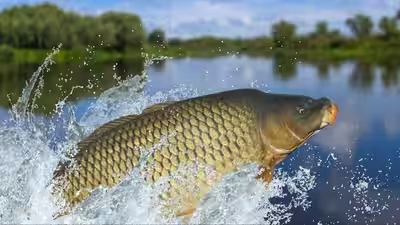
Tasmania spent 28 years removing invasive carp from two lakes; after 49,301 fish were taken out, the state declared carp functionally eradicated and trout began bouncing back

Invasive Species: Why Are Asian Carp a Problem? An intensive 28-year eradication campaign has eliminated common carp from two major Tasmanian lakes, achieving what fisheries experts around the world once considered almost impossible in a large, open freshwater system. The Tasmanian Inland Fisheries Service (IFS) has officially declared European carp (Cyprinus carpio) functionally eradicated from…

Read More