
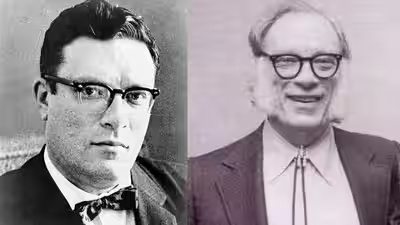
Quote of the day by Isaac Asimov: “The saddest aspect of life right now is that knowledge…” |

Image(s): Left/Wikipedia/Right/Fandom Humanity has never had access to information on the scale available today. With a few taps, we can find scientific discoveries, historical records, news and opinions from almost anywhere in the world. Yet having more information does not necessarily mean becoming wiser about how to use it. Isaac Asimov captured this tension in…
Read More

In 2025, a US startup blasted hard rock with high-voltage pulses and made it 10 times more permeable; now it is testing ‘underground lightning’ beneath a Massachusetts horse farm to make hydrogen

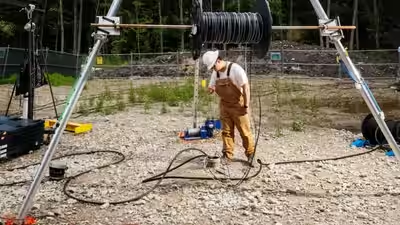
A worker prepares the well on a Boston-area horse farm to lower Eden’s electrode (Image Credit: Bob O’Connor via IEE Spectrum) What if the rocks beneath our feet could one day be turned into a giant hydrogen factory, not by drilling up an existing fuel reserve, but by sending controlled bursts of electricity deep underground?…

Read More

55 million-year-old penguin fossils reveal hidden chemical clues about Antarctica before the continent became frozen |

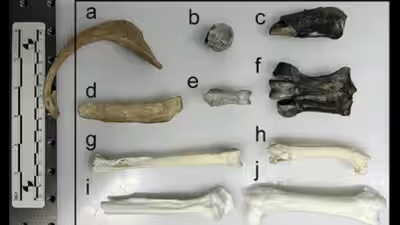
PC: Eocene penguin fossils as archives of Antarctic weathering and climate change: insights from micro-X-ray fluorescence elemental mapping Fifty-five million years ago, Antarctica looked nothing like the frozen continent we know today. Its coastlines were warm and humid, its shores home to some of the earliest penguins ever to exist, and its rocks were quietly…

Read More

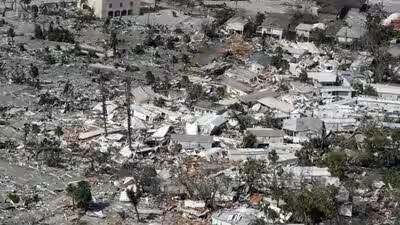
If New York’s worst recorded rainfall is 200 mm, what could a plausible 300-mm storm look like? MIT built an AI system to map extreme events that have never happened before

The method, called Extreme Event Aware, or “η-learning”, does not need previous extreme events to create these scenarios. (Representational AP photo) What would a once-in-a-century storm look like if it was stronger than anything recorded before? Researchers at the Massachusetts Institute of Technology (MIT) have developed a machine-learning method that can generate realistic scenarios for…

Read More

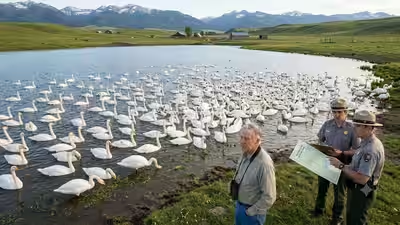
In the 1960s a Montana landowner bought 2 mute swans for private pond. Decades later their flock reached 120; alarming Yellowstone officials |

A pair of ornamental swans bought for a private pond in Montana in the 1960s eventually became the starting point for a very different kind of wildlife story. By the late 1970s, the flock in Paradise Valley had grown to 120, drawing the attention of Yellowstone National Park officials concerned about possible competition with native…

Read More

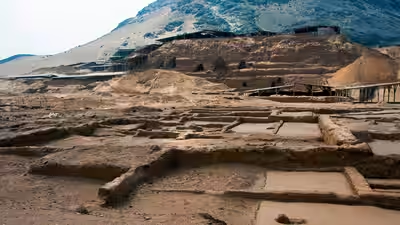
1,500-year-old child burial unearthed in Peru with whistles, a rattle and a striking sculptural vessel, archaeologists uncover clues to an ancient civilisation’s rituals

Huacas de Moche (Image Credit: Canva) Archaeologists working at the Huacas de Moche Archaeological Complex in northern Peru have uncovered the burial of an infant estimated to be about 1,500 years old. The child, approximately 1.5 years old, was buried with a funerary assemblage that included two whistles, a rattle and a sculptural vessel. Researchers…

Read More

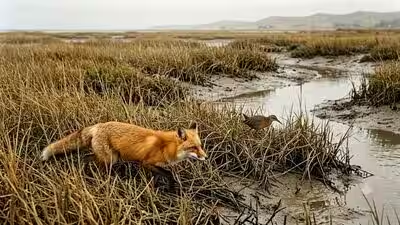
In the 1800s, red foxes were brought to California for hunting. Decades later, the light-footed Ridgway’s rail declined to just 5 breeding pairs |

A red fox introduced to California more than a century ago might seem far removed from the fate of a small marsh bird. Yet the two became linked in the coastal wetlands of Southern California, where the light-footed Ridgway’s rail has struggled to survive. The bird spends much of its time concealed among cordgrass and…

Read More

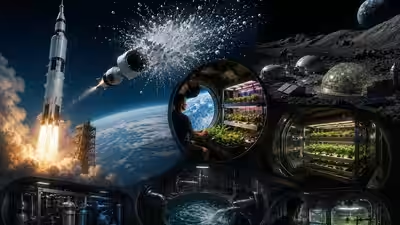
In 1962, NASA loaded 22,900 gallons of water onto a Saturn I rocket and deliberately blew the container apart 65 miles above Earth to study what water would do in the upper atmosphere

Representative Image (AI-generated) For humans to travel deeper into space and remain there for months or even years, they will need much more than powerful rockets. Astronauts must have a continuous supply of oxygen, water and food, while waste and carbon dioxide must be carefully managed. On short missions, these needs can largely be met…

Read More

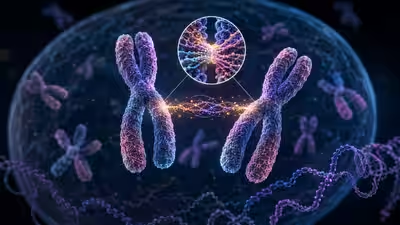
Scientists found that DNA once dismissed as “junk” helps chromosomes find their partners |

For years, the dense loops of repetitive DNA clustered near the middle of chromosomes were treated as evolutionary clutter. According to the new study published in Nature, titled ‘Meiotic pairing through barcode-like satellite DNA repeats‘, researchers working with fruit flies have shown that this so-called satellite DNA forms a kind of barcode: a unique combination…

Read More

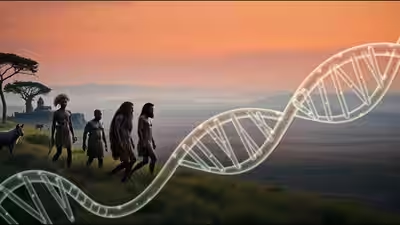
Scientists found traces of two unknown ancient human lineages hiding in modern DNA; one split from our ancestors about 800,000 years ago, another around 1.8 million years ago |

​Representative Image of ancient human evolution showing the genetic connections between humans, Neanderthals, and Denisovans (AI-generated image) Modern humans already carry small amounts of Neanderthal and Denisovan DNA, evidence that our ancestors interbred with other human groups tens of thousands of years ago. Both lineages are known from ancient remains, including fossils from which scientists…

Read More