







The Moon is about to get its own brain. For the first time, real-time artificial intelligence and edge computing have been installed on a lunar rover. The milestone might not make headlines like a rocket launch, but it is huge. 384,400 kilometres from Earth, machines will soon process data instantly, analysing sensor readings, images, and commands without waiting for signals to travel across the void.Astrolab, a California-based startup, confirmed in February 2026 that Hewlett Packard Enterprise’s Spaceborne Computer has been mechanically integrated on its FLIP rover. This is the first step in creating a smarter, faster, more autonomous lunar mission. Experts say the move could revolutionise how astronauts and robots operate on the Moon, particularly at the South Pole, where Artemis missions are targeting permanent outposts.
FLIP and FLEX: Inside Astrolab’s two rovers built for the Moon
FLIP, or FLEX Lunar Innovation Platform, is Astrolab’s smaller test rover. It weighs about half a ton and carries 30–50 kilograms of payload. Its purpose is simple: test key subsystems under real lunar conditions. That includes hyper-deformable Venturi wheels, batteries, avionics, sensors, and software. FLIP is scheduled to land on Astrobotic’s Griffin Mission-1 lander in summer 2026.FLEX is the big sibling. It’s the flagship rover, designed to carry two suited astronauts, transport cargo, deploy infrastructure, and perform construction tasks. It can carry up to 1,600 kilograms and store three cubic metres of equipment. FLEX uses bendable wheels for soft regolith, articulating limbs to adapt to terrain, deployable solar arrays, a six-degree-of-freedom robotic arm, and semi-autonomous navigation sensors. Experts say it might be the most capable rover ever planned for the lunar surface.
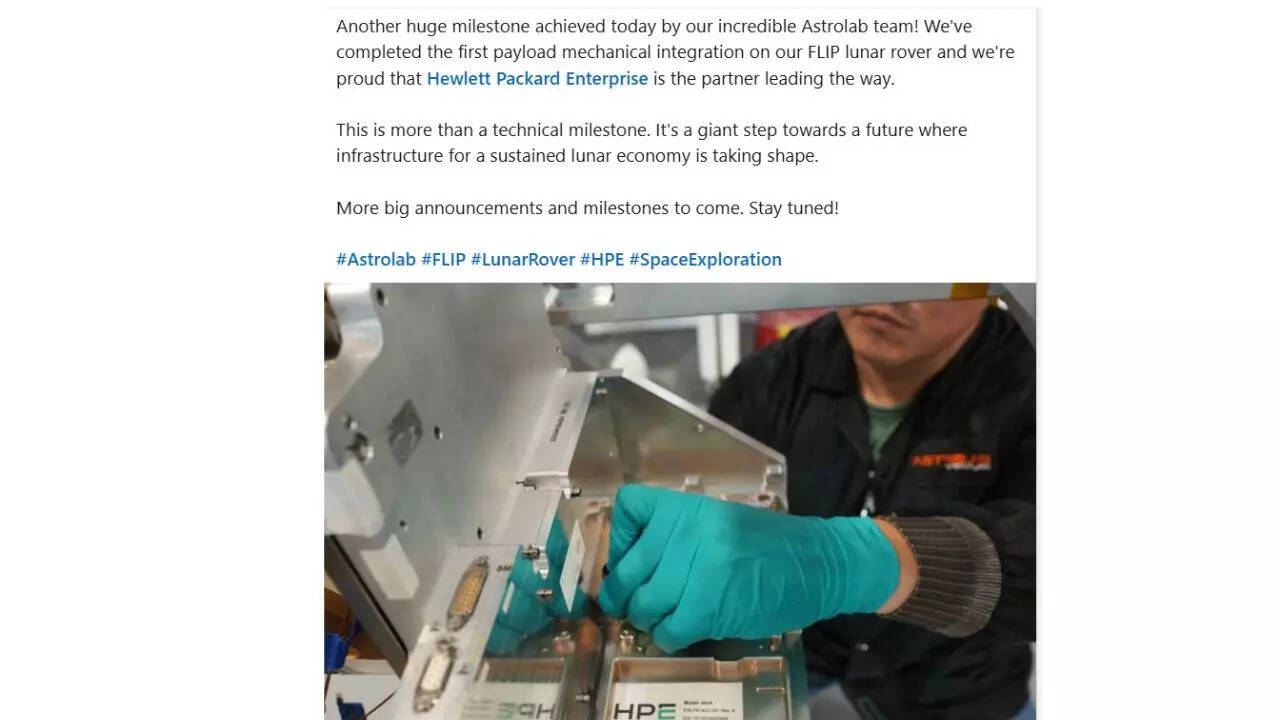
Source: LinkedIn
FLIP gets a brain: Smart AI for instant lunar decisions
With HPE’s Spaceborne Computer onboard, FLIP can analyse data immediately. No more sending massive files back to Earth and waiting hours or even days for answers. Images, sensor readings, and mission commands can be processed in real-time.For astronauts, this is a game-changer. They could instantly map water ice, detect Helium-3 deposits, interpret medical images, and control experiments without lag. Navigation becomes safer. And for future lunar bases, mining operations, and communication networks, having smart, autonomous machines on the Moon could make operations far more efficient.Some experts even see benefits beyond the Moon. Edge computing systems like this could improve operations in remote Earth locations like deep oceans, polar regions, and disaster zones where immediate data processing is essential.
AI meets the Moon: FLIP arrives this summer
FLIP is first in line, expected to land at the lunar South Pole in summer 2026 aboard Astrobotic’s Griffin-1 lander. FLEX missions will follow later that year or beyond, possibly using SpaceX vehicles. The Moon’s vacuum, polar sunlight, and radio-quiet zones make it ideal for AI-powered, edge-computing rovers.