




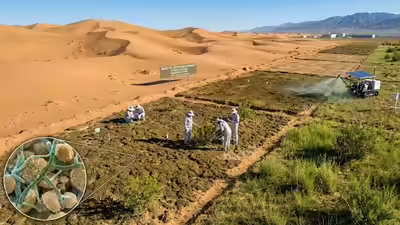
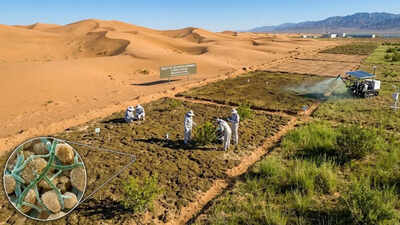
The researchers at the Shapotou Desert Experimental Research Station in China have developed a revolutionary approach for reversing desertification and converting barren, shifting sand into productive land within only 10 months. Using cyanobacteria, which are specialised, photosynthetic microorganisms, the researchers have created biological soil crusts that form a living layer on the surface of the dunes that continually shift. When the biological soil crusts are dispersed and applied onto the sand, they cause the cyanobacteria to secrete glue-like substances based on sugars that act to bind the individual grains of sand into a stable, solid mass. This process significantly reduces the time necessary for natural soil formation since it rapidly increases the levels of nutrients such as nitrogen and phosphorus. As a result, these biological soil crusts stabilise the sand on the desert floor and maintain moisture in the sand, thus providing a cost-effective, environmentally sustainable basis for successful plant growth in extreme, dry environments across the globe.
Research team in China transforms desert sand into fertile soil in 10 months
Cyanobacteria are microorganisms that can be grown in labs and added to the desert as a way to improve the desert ecosystem. These organisms can withstand extreme aridity; when water is present, they rapidly multiply and create a crust that protects against wind erosion and provides nutrients for shrubs and grasses to take root. This eliminates the primary challenges in establishing vegetation in unstable, nutrient-poor deserts.
How synthetic crusts outpace natural recovery
According to the study Soil Biology and Biochemistry, Biological Soil Crusts (BSCs) are living, thin layers of soil formed from soil particles adhering to polysaccharide excretions of cyanobacteria. They serve as the basis for ecological recovery. Studies suggest that applying these microbial communities will accelerate the rate of organic carbon accumulation by 3.2 times and nitrogen accumulation by approximately 15 times, as compared to the rate at which natural crusts form. Rapidly creating a stable ‘sandbed’ through chemical and physical processes will facilitate the establishment of many more complex organisms (e.g., lichens and mosses) as noted in research on PMC-NIH.
The science of biological soil crusts
Beyond initial stabilisation, this technology allows for a practical and low-maintenance approach to traditional, labour-intensive methods used for desert reclamation, such as tree planting by hand. The use of lab-grown strains that are drought-resistant means the method can be adapted to many dry climates outside of China. As noted in the research published on PMC-NIH, ongoing research into ‘synthetic microbial communities’ supports the potential for optimising specific bacterial strains to improve efficiency with crust formation, thus providing a foundation for developing global large-scale desertification control systems through automation.