



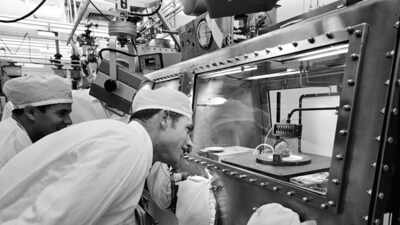
When Apollo 15 astronauts David Scott and James Irwin explored the Moon in 1971, they were looking for rocks that could reveal how the lunar surface formed. During their mission, they spotted an unusually bright fragment near Spur Crater, a small feature on the slope of Hadley Delta. The white rock immediately stood out against the darker lunar soil, and what looked like an ordinary piece of rock soon became one of the most famous samples returned from the Moon. According to NASA, the sample, officially numbered 15415, was an anorthosite and a piece of the Moon’s primordial crust. Scientists later determined that the rock was about 4 billion years old. Although it was initially considered a possible piece of the Moon’s oldest crust, NASA’s Lunar Sample Compendium notes that it may not actually be the oldest lunar rock ever collected.
A surprising discovery
The discovery happened on August 1, 1971, during Apollo 15’s exploration of the Hadley-Apennine region. Scott and Irwin had been carefully trained to recognise different types of lunar rocks and geological features before the mission. At Spur Crater, they noticed a small white fragment sitting on top of a darker piece of material. The Apollo 15 transcript records Scott pointing out the unusual white corner and deciding how best to collect it. The rock’s white, coarse-grained appearance suggested an anorthosite rich in plagioclase, a mineral commonly found in this type of rock. Scott famously reacted with excitement, telling Mission Control, “Guess what we found?” The astronauts believed they might have found exactly the kind of ancient crustal material that scientists had hoped Apollo 15 would uncover.
Why the rock mattered
The Genesis Rock was important because scientists wanted to understand how the Moon’s earliest crust formed. Anorthosite is particularly significant because lunar scientists generally believe that much of the Moon’s original crust formed when crystals of plagioclase floated upward from a global ocean of molten rock, eventually creating a lighter crust above the denser material.NASA’s Lunar Sample Compendium describes sample 15415 as an anorthosite composed almost entirely of coarse-grained plagioclase. Its mineral composition and coarse-grained structure made it an especially valuable sample for studying the Moon’s geological history. The rock was found on the rim of Spur Crater. Its location also made it scientifically interesting because material excavated or exposed by impacts can bring rocks from deeper layers to the surface, allowing astronauts to collect material that would otherwise remain buried.
Nearly 4 billion years old
Determining the age of Genesis Rock was not straightforward. NASA’s sample records explain that age dating was difficult, but analyses placed the rock at roughly 4 billion years old. Later research suggested that the measured age may reflect a subsequent geological event rather than the rock’s original formation. That age places the rock close to the earliest chapters of lunar history. The Moon itself formed roughly 4.5 billion years ago, meaning this rock preserves evidence from a period when the young Moon was still undergoing major geological changes.The name “Genesis Rock” came from the idea that the sample could represent material from the Moon’s earliest crust. However, scientists later became more cautious about that interpretation. NASA explains that while the rock is ancient, it is not necessarily the oldest lunar sample brought back by the Apollo missions.
A window into lunar history
The Genesis Rock is valuable not simply because of its age, but because of what its minerals reveal. Its abundance of plagioclase supports the broader scientific picture of an early lunar magma ocean and the formation of an ancient crust through the accumulation of lighter crystals.At the same time, researchers found that the precise connection between sample 15415 and the Moon’s original magma ocean is not completely certain. NASA’s sample records note that some dating results suggest the rock may be younger than material expected from the very earliest stage of lunar crust formation.
A lasting Apollo discovery
Apollo 15 was designed with science as a major priority. It was the first of NASA’s three advanced “J missions,” allowing astronauts to spend longer periods on the Moon and explore larger areas using the Lunar Roving Vehicle. Scott and Irwin spent almost 19 hours conducting lunar surface exploration and travelled about 17.5 miles in the rover. The white fragment they collected became one of the mission’s most memorable discoveries. More than five decades later, sample 15415 remains an important piece of lunar material, offering scientists a physical record of the Moon’s ancient crust and helping explain how its surface evolved.What appeared to Apollo 15 astronauts as a small, unusual white rock ultimately became a remarkable geological time capsule, one that has allowed scientists to study events that occurred billions of years before humans ever set foot on the Moon.