





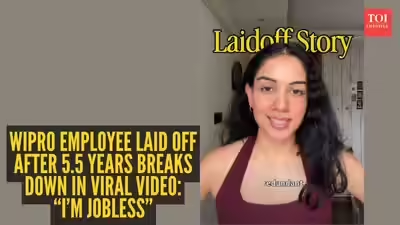
There is a unique kind of comfort that comes with staying at a company for over half a decade. You know the exact cadence of your days, you understand the unwritten rules of the office, you have your favorite coffee corners, and your coworkers have long transitioned from mere names on an email thread to the people who know your daily quirks. For five and a half years, Anukriti Vidyarthi built that exact kind of life at Wipro. As a marketing and communications coordinator for Wipro AI Solutions, her career was stable, predictable, and deeply woven into her identity.Then came June 29, 2026.It started like any other Monday. An invitation popped up on her calendar: A quick sync with her manager and an HR representative. In the corporate world, these calls happen all the time. You log on expecting to discuss a project update, a budget adjustment, or maybe a routine organizational shift. Instead, within a matter of minutes, Anukriti’s world was completely turned upside down. She wasn’t being redirected; she was being let go. Her role had been deemed “redundant.”“I’m jobless. Today is 29th June, 2026… and they told me that my role is redundant and I’ve been asked to leave the company.”The raw, unfiltered video she posted on Instagram shortly after hitting “Leave Meeting” has since gone viral, not because what happened to her is rare, but because she said out loud what thousands of corporate professionals secretly panic about every single day.
The anatomy of the word “Redundant”
When human resources professionals use words like restructuring, downsizing, or role redundancy, they do it to detach the human being from the spreadsheet. But to the person sitting on the other side of the screen, the word “redundant” cuts incredibly deep. It implies that your contribution, your late nights, your years of loyalty, and your presence have suddenly been reduced to a line item that can be neatly erased.For Anukriti, the initial shock wasn’t just about losing a title; it was about the sudden shattering of a routine that had sustained her for more than five years. When you spend that long in one place, you stop viewing the company as just an employer. It becomes a central pillar of your daily existence. Facing the reality of having to start entirely from scratch is a psychological gut punch.

In her video, she didn’t mask her vulnerability with polished corporate PR talk. She admitted to being utterly terrified of the unknown.“I don’t know if I’m gonna make it, and what I’m gonna do… I have no clue. And I never thought that I’ll be here at this stage. But I am.”
The reality of the missing paycheck
While it is easy for career coaches to tell people to “look at the bright side” or “see this as an opportunity for growth,” Anukriti hit on the most agonising, practical fear that anyone who has ever been laid off faces: the sudden death of the monthly salary credit.A regular paycheck isn’t just money in a bank account. It is the invisible net that allows you to pay rent on time, clear your EMIs, buy groceries, plan for your future, and sleep peacefully at night. When that safety net is abruptly pulled away, it triggers an immediate, survival-level anxiety. Anukriti openly voiced this financial dread, noting that she now has to face a future where nothing is guaranteed: where she might earn less, or more, but the comforting predictability of that text message on the 1st of the month is officially gone.

“Bhagwan ne bola, niklo bhai” — Reframing the trauma
What truly made Anukriti’s video go viral across India wasn’t just her honesty about the pain, but how she chose to process it. In a moment where she could have easily leaned into entirely justified anger, bitterness, or despair, she chose a path of profound, spiritual surrender.With a bittersweet smile, she explained that she probably would have never had the courage to walk away from the golden handcuffs of her stable job on her own. She would have stayed in her comfort zone forever.“Maybe it’s a sign from God because mujhe lagta hai ki main kabhi naukri khud se chhodti. Toh Bhagwan ne bola, ‘Niklo bhai ab yahan se, bahut ho gaya tumhara.'”This single sentence struck a massive chord online. It flipped the narrative from being a victim of corporate coldness to being a main character pushed into their next necessary chapter by the universe. By reframing a corporate firing as a divine intervention, she gave herself—and thousands of others watching her—permission to stop asking “Why me?” and start asking “What’s next?”

The internet becomes a virtual watercooler
The flood of comments beneath her video highlights a massive cultural shift in how we handle career setbacks today. A few years ago, losing your job carried a silent stigma. People hid it, quietly updated their LinkedIn profiles, and felt a deep sense of personal failure.Today, the internet has become a massive, collective support group. The response to Anukriti’s story was a beautiful mix of radical empathy, shared corporate trauma, and practical advice. Dozens of people jumped in to share how their own sudden layoffs years ago, which felt like the end of the world at the time, ended up forcing them to start businesses, pivot to happier industries, or find roles that actually valued them.Her vulnerability broke down the corporate facade. By refusing to quietly fade away and instead choosing to look into the camera and say, “I am starting from zero,” Anukriti didn’t just share her own pain. She reminded every single professional navigating this brutal market that their worth is not dictated by an HR manager’s calendar invite, and that sometimes, a devastating ending is just a fiercely disguised beginning.