



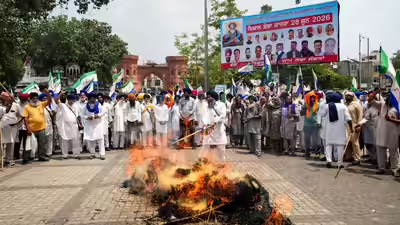
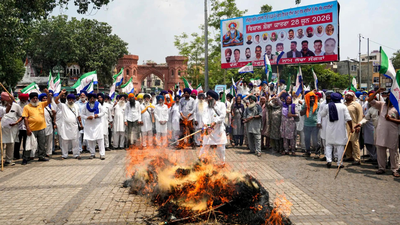
NEW DELHI: Farmers under the banner of the Kisan Mazdoor Morcha (KMM) held protests at several locations across Punjab on Wednesday against the proposed India-US trade agreement, alleging that the pact could harm farmers, labourers, small traders and the youth.The protesters burnt effigies of Prime Minister Narendra Modi and US President Donald Trump while demanding immediate cancellation of the proposed trade agreement.The demonstrations were organised following a call by KMM, with protests and effigy-burning programmes held at nearly 28 locations across 21 districts of Punjab.Protesters raised slogans against the central government and opposed what they described as “anti-farmer and anti-worker” policies.
Farmers raise concerns over agricultural imports
In Hoshiarpur, the protest was led by district president Paramjit Singh Bhulla, who alleged that the trade agreement would open India’s agricultural market to foreign products and put additional pressure on small and marginal farmers.Farmer leaders claimed that the pact could lead to increased imports of agricultural commodities such as pulses, fruits, vegetables and other food items, affecting domestic farmers’ incomes and the agriculture sector.They argued that American farmers receive large-scale government support and operate on bigger landholdings, making it difficult for Indian farmers, who mostly have smaller farms, to compete.The protesters also alleged that government trade policies were favouring multinational companies and global trade interests at the expense of farmers and the dairy sector.
Opposition linked to farm laws debate
KMM leaders accused the government of following a similar approach to the three farm laws, alleging that farmers’ organisations and other stakeholders were not consulted before decisions affecting agriculture were taken.They demanded the cancellation of the India-US trade agreement, withdrawal of the Electricity Amendment Bill 2025 and Seed Bill 2025, besides opposing the installation of smart electricity meters.The leaders said the issue was not restricted to farmers alone and could affect labourers, small traders, employees and ordinary citizens.
India-US trade talks continue
The protests come as India and the US continue negotiations on the first phase of their Bilateral Trade Agreement (BTA). The two countries recently concluded a two-day ministerial-level round of talks in New Delhi, where commerce and industry minister Piyush Goyal and US trade representative Jamieson Greer reviewed progress on the proposed interim pact.The commerce ministry said discussions covered issues including enhanced market access, digital trade and reducing non-tariff barriers.The two sides are aiming to conclude an interim agreement before the expiry of the US temporary 10 per cent tariff on imports from trading partners on July 24.
Demand for MSP and irrigation reforms
During the protests, Bhartiya Kisan Union (Doaba) president Manjit Singh Rai said the recent remarks by agriculture minister Shivraj Singh Chouhan on possible uneven monsoon conditions highlighted the need for better preparedness.Rai reiterated farmers’ demand for a legal guarantee of Minimum Support Price (MSP) for all crops and called for promoting water-saving farming practices and better utilisation of canal irrigation facilities.He also suggested forming district-level teams to address agricultural challenges and prepare farmers for weather-related risks.The India-US trade agreement negotiations have become a major point of debate among farmer groups, with unions raising concerns over market access, competition and the possible impact of increased agricultural imports on domestic producers.