




For decades, wind power has relied on a familiar formula: enormous towers, vast concrete foundations and specialised heavy-lift equipment capable of transporting and assembling components that can weigh hundreds of tonnes. While effective, these requirements have limited where wind turbines can be deployed and increased both costs and environmental impacts. Now, a new generation of recyclable, modular wind energy systems is challenging that model. With the capacity to be moved in small units, constructed with little infrastructure, and produced mostly out of recycled materials, such turbines could make renewable energy accessible to places where it was thought unfeasible before. Proponents argue that this could contribute to extending the production of clean energy despite the rising issues with resource consumption, transportation emissions, and waste in the wind energy sector. It creates an entirely new concept of the wind turbine.
Why this recyclable wind turbine does not need concrete foundations or giant cranes
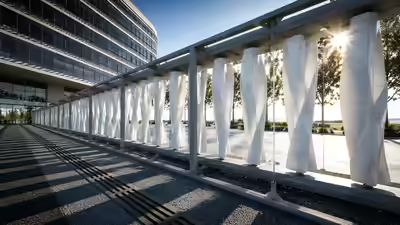
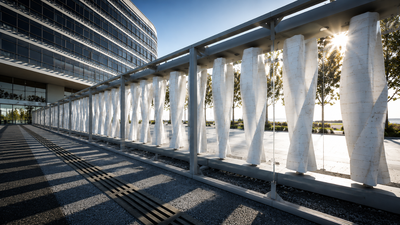
Traditional utility-scale wind turbines typically require extensive groundwork before installation begins. Large concrete foundations anchor the structures, while specialised cranes are needed to lift towers and blades into position.The latest modular designs take a different approach. Companies developing these systems are focusing on smaller, scalable units that can be transported in standard-sized components and assembled on-site with significantly less equipment. One example is the Airiva modular wind energy system, which consists of interconnected vertical-axis turbines designed to be deployed in locations where conventional turbines are difficult to install.According to the World Intellectual Property Organisation (WIPO), Airiva’s design documentation:“The design is modular for easy transportation and is scalable to reflect site-specific needs.”Because the system is composed of smaller modules rather than a single towering structure, installation requirements can be reduced considerably. This opens opportunities for deployment along transport corridors, industrial estates, campuses and urban environments where conventional wind farms may not be practical.
The breakthrough materials making wind turbines recyclable for a circular economy
One of the biggest challenges facing the wind industry has been blade disposal. Although recycling is possible for steel towers and numerous parts of turbines, the blades have often proved difficult to recycle once their life cycle comes to an end.Scientists and engineers are working on the development of materials that overcome this challenge. The Zero Waste Blade Research (ZEBRA) project has developed the first ever recyclable thermoplastic wind turbine blade.The consortium stated:“The first prototype of its 100% recyclable wind turbine blade.”Similarly, Siemens Gamesa introduced the world’s first commercially deployable recyclable blade technology, designed to allow valuable materials to be recovered and reused after decades of operation.According to the company’s official press release:“The world’s first wind turbine blade that can be recycled at the end of its lifecycle.”These developments represent a significant shift away from the traditional take-make-dispose model that has long characterised composite materials in the renewable energy sector.
Could modular recyclable wind turbines make clean energy accessible almost anywhere
The greatest promise of modular turbine systems lies in flexibility.Conventional wind farms are often constrained by geography, transport logistics and construction costs. By contrast, modular systems can be adapted to local conditions, expanded over time and integrated into environments that would normally be unsuitable for large-scale turbines.Airiva’s developers aim to manufacture the system using at least 80 per cent recycled and post-consumer materials, further reducing the environmental footprint of deployment.This is part of a bigger trend in the wind industry towards design that allows for reuse. Along with more sustainable blade designs and recycling technology, engineers are becoming concerned with making the turbine more efficient in its material use and easier to install.The shift is still in its nascent stage, and there will continue to be a high prevalence of traditional turbines in utility-scale power production for years to come. However, developments in the realm of recyclable materials and design mean that wind power of the future could be a very different story. Turbines could become much smaller and assembled in pieces, making them easy to assemble and recycle in the process.