




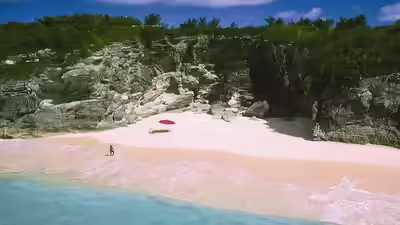
Bermuda is famed throughout the world for its crystal-clear blue water and pink sand beaches, but the mysteries under the sea have begun to challenge everything we thought we knew about the Earth. Scientists have long thought that Bermuda was simply the result of a hotspot, a vertical tube of heat from the mantle similar to how Hawaii was formed. But chemical analysis has shown that Bermuda’s true origins are not that straightforward and are quite unusual compared to a typical volcanic plume.Bermuda is composed of rock formations with a distinct chemical fingerprint that does not resemble the usual composition of oceanic islands. According to scientists, Bermuda may be a rare message sent by some unseen “reservoir” located deep inside the interior of the planet. The findings imply that the mantle of the planet, previously considered to be simply a giant rotating mass of rock, is rather a complicated system with secret layers of storage.Today, scientists believe that the birth of Bermuda included a disruption in the layer containing high-volatility substances, which got squeezed up to the surface. Therefore, the island is not only volcanic, but also a unique look into the internal structure of our planet that had always been impossible for scientists to get their hands on. It is a fantastic discovery that proves to us that the Earth has many secrets to offer and can surprise us with new structures buried hundreds of miles beneath the Earth’s crust.The enigma of the transition zoneAll the mysteries connected with the unusual composition of Bermuda hide somewhere under the Earth’s mantle transition zone. This region is located at a depth of 250-400 miles underground and separates the upper and lower regions of our planet. In the past, the mantle transition zone was thought to be just an ordinary demarcation line between two parts of the mantle. Still, nowadays, scientists have come to believe that it is a great storage site for recycled material.According to a study called Sampling the volatile-rich transition zone beneath Bermuda, it was found that volcanic rocks that exist in Bermuda have a very high presence of water and heavy isotopes of lead. The chemicals are used as tracers of where these regions came from. These chemicals show that these substances did not originate from the core-mantle boundary; rather, they are products of the transition zone because these rocks formed when lava was squeezed 30 million years ago.However, it is worth mentioning that the discovery of this water reservoir indicates that our planet has what scientists call an “extended memory”. It is assumed that the components of materials that exist on the surface of Bermuda could be created from fragments of the ancient oceanic crust that were hidden underground as a result of the formation of Pangea, a supercontinent. This happened many millions of years ago, but later these materials were pushed to the surface by volcanic activity, creating the island.
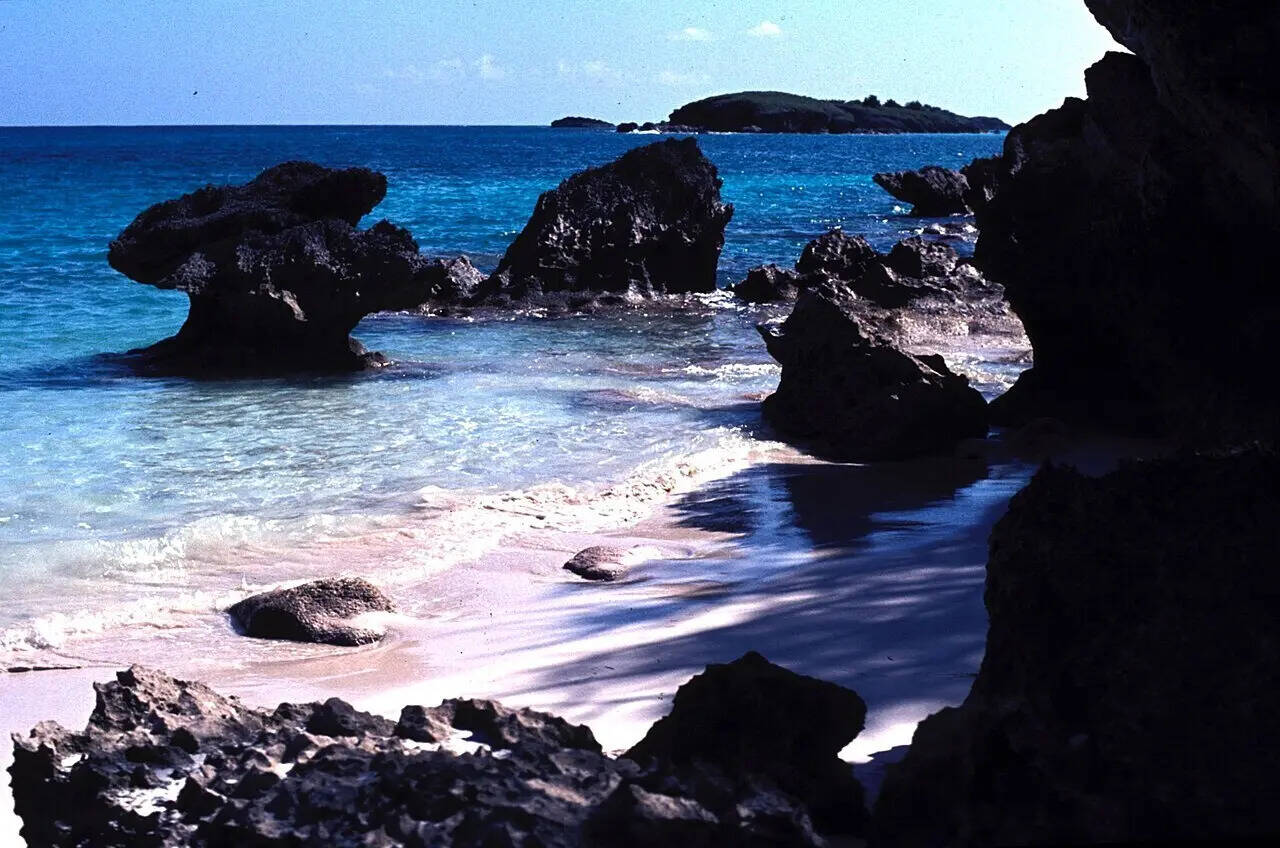
This discovery offers a rare glimpse into the planet’s internal structure, revealing a layered system rather than a uniform mass, with recycled ancient materials brought to the surface. Image Credits: Wikimedia Commons
A new map of the inner earthThe discovery of this water reservoir requires geologists and other experts studying the structure of the Earth to reconsider their models regarding the distribution of the Earth’s inner materials. At first, all materials of the Earth’s core were thought to be homogeneously distributed like the ingredients in a blender.A research titled Compositional heterogeneity in the mantle transition zone, for example, investigates how widespread such invisible reservoirs may be. According to the researchers, it is not a homogeneous layer; it is a “patchwork” of various chemical regions within the Earth’s mantle. Bermuda was merely fortunate enough to witness such a patch being brought up to the surface, thus affording geologists a sample of what lies beneath.This new concept implies that other volcanic islands may similarly utilise their own specific reservoir. The new paradigm suggests that there is a far greater degree of stratification within the Earth’s interior than had previously been considered. Rather than being the product of a plume, Bermuda reflects the complexities of layer interactions within the mantle.The citizens of Bermuda now have yet another reason to marvel at where they live. The whole island is, essentially, formed of the recycled material of a world that existed long, long ago, retrieved from a hidden cache buried hundreds of miles below the ground. It transforms a small Atlantic island into an enormous scientific monument, showing us how the most mysterious secrets of the Earth are not necessarily to be found on its surface, but rather within the very ground itself.